
You’ve been told your child has a developmental delay, and now you’re wondering whether early intervention is worth the time, the appointments, and the emotional energy. It’s a fair question, especially when you’re already stretched thin.
Early intervention services help young children build communication, motor, and social skills during the years when the brain is most adaptable. This guide covers seven specific benefits backed by research, how to access services, and what you can do at home to support your child’s progress.
What early intervention services are
Early intervention services are specialized therapies for infants and toddlers from birth to age three who have developmental delays or disabilities. According to the CDC, early intervention can have a significant impact on a child’s ability to learn new skills and overcome challenges. The programs work by taking advantage of the brain’s rapid growth during the first few years of life, when neural connections form faster than at any other time.
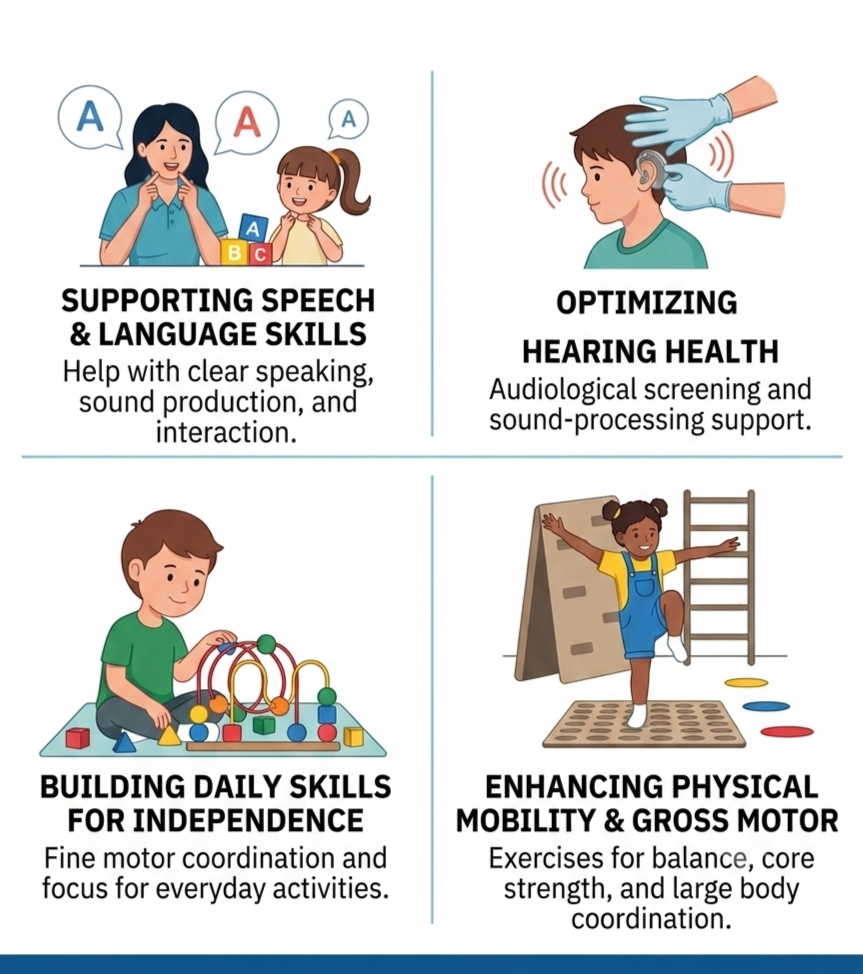
What does early intervention actually look like? It depends on your child’s specific needs. A team of specialists evaluates your child and then creates a plan with the services that fit. Here’s what families typically see:
- Speech therapy: Helps children learn to communicate, whether through words, gestures, or picture boards
- Occupational therapy: Works on fine motor skills like grasping a spoon or picking up small objects, plus daily activities like feeding and dressing
- Physical therapy: Focuses on movement, strength, and coordination for sitting, crawling, standing, and walking
- Developmental therapy: Supports thinking skills and play-based learning
- Family training: Teaches you how to practice therapy goals at home between sessions
The services usually happen in your home or wherever your child spends time, like a daycare. That’s intentional. Children learn best in familiar settings, and you get to see exactly how the therapist works with your child.
Why the first five years shape a child’s future
Your child’s brain is building more than one million new neural connections every second during the first few years of life, according to the Harvard Center on the Developing Child. That’s not a metaphor. The brain is literally constructing the architecture that will support all future learning, behavior, and health.
This is why timing matters so much. When a child has a developmental delay, the brain is still flexible enough to respond to therapy in ways that become harder later. A gap in motor skills at age two, for example, can widen by age five if nothing changes. Early intervention works to close that gap while the brain is still in its most adaptable state.
You might be wondering: does waiting a few months really make a difference? Often, yes. The earlier support begins, the more time the brain has to build on the progress. That said, starting later is still better than not starting at all.
7 proven benefits of early intervention services
1. Stronger communication and language skills
Many children in early intervention learn to express what they want, understand what others say, and have back-and-forth exchanges with the people around them. Speech therapy targets whatever is getting in the way, whether that’s forming sounds, processing language, or using gestures to communicate.
The progress often shows up in small moments first. A child who couldn’t ask for a drink starts pointing and saying “wa.” A toddler who seemed disconnected begins turning toward their name. Over time, those small gains add up to real changes in how your child connects with you and with others.
2. Improved motor skills and physical independence
Physical and occupational therapy help children build the strength and coordination they need to move through their world. For some children, that means learning to sit up, crawl, or walk. For others, it means holding a crayon, climbing stairs, or feeding themselves with a fork.
Each motor milestone opens new doors. A child who can walk independently explores more, plays differently, and gains confidence. A child who can use their hands to stack blocks or turn pages is better prepared for the fine motor demands of preschool. The gains in therapy translate directly into gains in daily life.
3. Healthier social and emotional development
Early intervention therapists often work on skills that help children regulate their emotions and connect with others. This might include learning to take turns during a game, recognize when someone is happy or upset, or calm down after a frustration.
Children who struggle with social and emotional skills can become isolated or overwhelmed in group settings. Therapy gives them tools to participate. Parents frequently notice that their child becomes more engaged at family gatherings or less anxious around other kids as therapy progresses.
4. Reduced need for special education later
Children who receive early intervention often require fewer intensive services once they enter school. The CDC notes that early support can lessen or even eliminate the need for special education placements in some cases.
This doesn’t mean every child will “catch up” completely, and that’s okay. The goal is to give your child the strongest possible foundation. A child who enters kindergarten with better communication, motor, and social skills is more likely to keep pace with peers and less likely to need pull-out services or a separate classroom.
5. Better school readiness and learning outcomes
School readiness involves more than knowing colors and counting to ten. It includes the ability to follow a routine, sit in a group, hold a pencil, and respond when a teacher gives directions.
Early intervention targets exactly those foundational skills. A child who has worked on attention, motor control, and communication is more prepared to participate in a classroom. Research from the University of Louisiana at Monroe confirms that early intervention contributes to positive changes in language, cognitive development, and academic achievement.
6. More confident and less stressed families
Early intervention is designed to support the whole family, not just the child. Therapists coach you on what to do at home, which helps you feel more capable and less overwhelmed.
Because services often happen in your home, you get to watch the therapist work and ask questions in real time. You learn why certain activities help and how to weave them into your daily routine. Many parents say that understanding their child’s needs and having a clear plan reduces the stress and uncertainty they felt before starting services.
Tip: Keep a notebook or use your phone to jot down questions between sessions. Therapists appreciate when parents come prepared, and you’ll get more out of each visit.
7. Long-term cost savings for families and communities
Investing in early childhood development produces returns that extend well beyond the individual child. Economist James Heckman’s research, known as the Heckman Equation, demonstrates that high-quality early childhood programs generate economic benefits by reducing the need for remedial education and improving adult outcomes.
For families, early intervention can reduce the total cost of services over a child’s lifetime. Addressing a delay at age two is typically less expensive than providing intensive support at age ten. Communities benefit when more children enter school ready to learn and fewer require costly special education placements later.
How to access early intervention services for your child
Early intervention is a federally mandated program under Part C of the Individuals with Disabilities Education Act (IDEA). Every state has a lead agency that coordinates services, and families can request an evaluation at no cost. You don’t need a doctor’s referral to get started.
Here’s how the process typically works:
- Contact your state’s early intervention program. You can refer your own child, or a pediatrician, childcare provider, or family member can make a referral. The CDC maintains a directory of state programs at cdc.gov/ncbddd/actearly.
- Request a developmental evaluation. A team of specialists will assess your child’s development across multiple areas. The evaluation is free.
- Receive an Individualized Family Service Plan (IFSP). If your child qualifies, the team creates a written plan that outlines goals and the services your child will receive.
- Begin services. Therapy is usually delivered in your home or another setting where your child spends time.
If your child is approaching age three and still needs support, the early intervention team will help you transition to preschool special education services under Part B of IDEA.
How parents can support early intervention at home
Build therapy into daily routines
The activities a therapist teaches work best when they become part of everyday life. Bath time, meals, and play are all opportunities to practice skills without adding extra “therapy time” to your day.
If your child is working on communication, you might pause during a favorite game to encourage a request. If motor skills are the focus, you might set up safe spaces for climbing or offer toys that require grasping and releasing. Your therapist can suggest specific activities that match your child’s goals.
Track milestones and share notes with therapists
Keeping a simple log of what you observe helps the therapy team adjust the plan. You might notice that your child said a new word, took steps in a new environment, or had an easier time calming down after a tantrum.
Therapists see your child for a limited time each week, and your input fills in the gaps. A quick note on your phone or a shared document can make sessions more productive.
Connect with other families and local resources
Parenting a child with developmental needs can feel isolating, especially in the early days. Connecting with other families who understand what you’re going through provides emotional support and practical advice.
NGO for special needs donations like Cara Mia Kids offer community connections for families seeking belonging and additional resources. Peer support groups, parent training workshops, and family events can help you feel less alone on this path.
Giving every child the start they deserve
Early intervention changes the trajectory of a child’s life. The benefits extend beyond the child to the entire family and, over time, to the broader community.
No family should miss this window because of cost, confusion, or lack of access. If you have concerns about your child’s development, reaching out for an evaluation is a concrete first step. The earlier support begins, the more time the brain has to build on that foundation.
At Cara Mia Kids, we believe every child deserves to feel understood, supported, and celebrated. We work alongside families to make early intervention possible, regardless of financial circumstances.
Explore more resources for early child intervention services
Frequently asked questions about early intervention services
What are the three main goals of early intervention?
The three main goals are to support the child’s development in areas of delay, strengthen the family’s ability to help their child grow, and prepare the child for future learning environments like preschool or kindergarten.
What age range does early intervention cover?
Early intervention services are available for infants and toddlers from birth through age three. After age three, children may transition to preschool special education services under Part B of IDEA.
Who pays for early intervention services?
Evaluations and many services are provided at no cost to families under the federal IDEA Part C program. Some states use a sliding fee scale for certain services, but no child can be denied services due to inability to pay.
Are there any drawbacks to early intervention?
Early intervention is widely supported by research and has few drawbacks. The main challenges families report are scheduling therapy appointments around work and childcare, and the emotional adjustment that comes with a new diagnosis or developmental concern.
What is the difference between early intervention and special education?
Early intervention serves children from birth to age three and focuses on family-centered support delivered in natural environments like the home. Special education under IDEA Part B serves children ages three and older, typically in school-based settings with a different planning document called an IEP (Individualized Education Program).