
Your toddler points at everything but rarely says a word. You’ve read that kids develop at their own pace, but something feels off, and you’re wondering what you can actually do at home while waiting for that evaluation appointment.
Early intervention speech therapy techniques are designed to fit into the moments you’re already sharing with your child, from breakfast to bath time. This guide covers the specific approaches speech-language pathologists recommend, how to spot signs that your child might benefit from support, and practical ways to turn everyday routines into language-building opportunities.
What is early intervention speech therapy
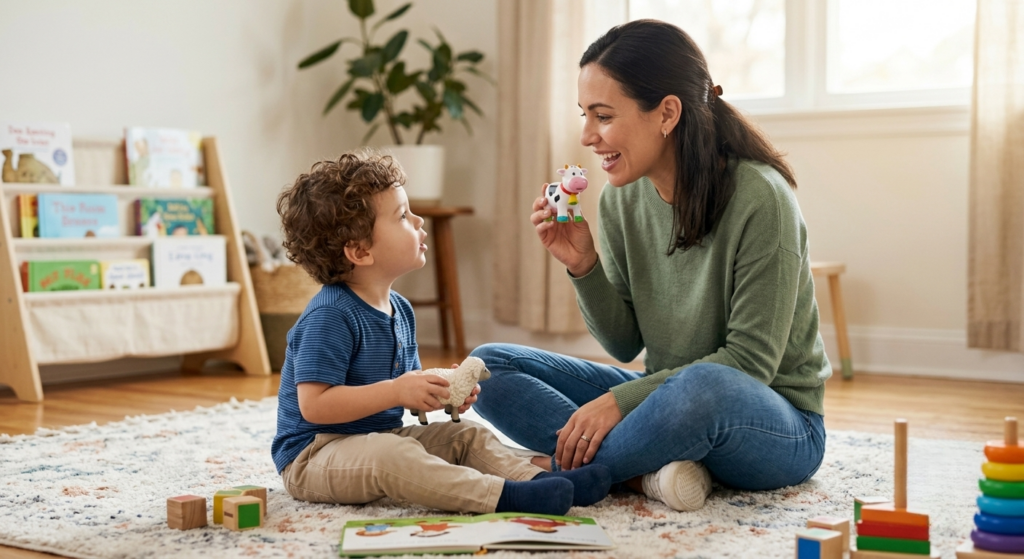
Early intervention speech therapy uses naturalistic, play-based approaches woven into daily routines to build communication in young children. The core methods include following the child’s lead, self-talk and parallel talk, expanding phrases, and pausing to allow a response. Parents and speech-language pathologists (SLPs) work together to model correct speech and create communication opportunities throughout ordinary moments like mealtime, bath time, and play.
Most early intervention speech services support children from birth through age three, though some programs continue through age five. Sessions often happen in the home, where a child feels comfortable and where parents can practice alongside the therapist. The goal is to turn everyday interactions into language-learning moments.
Why early speech therapy matters before age five
A child’s brain builds most of its architecture before age five, according to the Harvard Center on the Developing Child. Neural connections form faster during this window than at any other point in life, which makes early childhood the prime time for language learning.
When children receive speech support during this period, they often enter school with stronger vocabulary and better social skills. They also tend to have fewer behavioral challenges tied to communication frustration. Waiting to “see if they grow out of it” can mean missing the window when support has the greatest impact.
Signs your toddler may benefit from speech therapy
Spotting early signs gives you the chance to act while your child’s brain is most ready to learn. The milestones and red flags below can help you decide whether to request an evaluation.
Speech delay signs by age
| Age | Expected milestone | Possible concern |
| 12 months | Babbles with varied sounds, says “mama” or “dada” | No babbling, no gestures like waving or pointing |
| 18 months | Uses at least 5–10 words, follows simple directions | Fewer than 5 words, does not point to show interest |
| 24 months | Combines two words (“more milk”), vocabulary of 50+ words | Fewer than 25 words, no two-word phrases |
| 36 months | Uses three-word sentences, strangers understand most speech | Speech difficult for unfamiliar listeners to understand |
Language and social communication red flags
Beyond word counts, pay attention to how your child connects with others:
- Limited eye contact during play or conversation
- Does not respond to their name consistently
- Relies on gestures or pulling your hand instead of using words
- Has difficulty understanding simple directions like “get your shoes”
Noticing any of the above is a positive step. It means you’re paying attention, and early attention leads to early support.
Evidence-based early intervention speech therapy techniques
The approaches below come from research on naturalistic language intervention. Each one fits into everyday moments rather than requiring separate “therapy time.”
Following the child’s lead
Watch what your child gravitates toward, then join in. If they pick up a toy car, sit beside them and make car sounds together instead of redirecting to flashcards or a different activity.
Children learn language best when they’re already engaged. You’re adding words to something that already has their attention, which makes the words stick.
Self-talk and parallel talk
Self-talk means narrating what you’re doing: “I’m pouring the juice.” Parallel talk means narrating what your child is doing: “You’re stacking the blocks so high!”
Neither approach requires your child to respond. You’re simply filling their environment with language connected to real actions they can see and feel. Over time, they start to connect words with meaning.
Expansion and recasting
When your child says “ball,” you respond, “Yes, big red ball!” That’s expansion. You take their word and add to it without asking them to repeat.
Recasting corrects grammar without criticism. If your child says “doggy runned,” you say, “The doggy ran fast!” They hear the correct form modeled naturally, and you keep the conversation going.
Prompting and cueing
Prompting gives your child a hint to encourage a response. For example, hold up two snack options and wait for them to point, vocalize, or attempt a word before handing anything over.
You can also pair spoken words with gestures, signs, or picture cards. Multimodal cues support children who are late talkers or nonverbal by giving them multiple ways to understand and communicate.
Wait time
After you speak, pause for 5–10 seconds before jumping in again. This expectant pause gives your child time to process what you said and form a response.
Parents often fill silence quickly because it feels awkward. But that silence is where your child’s communication has room to emerge. Counting to ten in your head can help.
Communication temptations
Communication temptations are setups that give your child a reason to communicate. For example:
- Put a favorite toy in a clear container they can’t open
- Give them a snack in packaging they need help with
- “Forget” to give them a spoon at mealtime
The idea is to create a situation where words (or gestures, or signs) get results. Your child learns that communicating works.
How to use speech therapy techniques during daily routines
Embedding language-building approaches into routines you’re already doing is the foundation of naturalistic intervention. You don’t need to carve out extra time. You just add language to what’s already happening.
Mealtime and snack time
Use parallel talk to describe foods: “You’re eating crunchy crackers.” Offer choices like “apple or banana?” and wait for a response before handing anything over.
Giving small portions creates natural opportunities for your child to request more. That single word, “more,” becomes functional and meaningful because it gets them what they want.
Bath time and bedtime
Predictable phrases build language through repetition. “Water on,” “splash splash,” and “night night” become familiar anchors your child can anticipate and eventually say themselves.
Sing songs with pauses so your child can fill in the last word. Label body parts during washing: “Wash your tummy. Wash your toes.” Repetition in a calm, predictable setting helps words stick.
Car rides and errands
Point out and label what you see: “Look, a bus!” Narrate the trip in simple language: “We’re going to the store.”
Familiar songs work well here too. Pause before the last word of each line and see if your child fills it in. Even if they don’t respond right away, they’re listening and learning.
Getting dressed and cleanup
Use simple action words: “Shoes on,” “arms up,” “zipper down.” Let your child choose between two shirts, prompting them to communicate a preference.
A cleanup song creates routine language and makes transitions predictable. Predictability supports language learning because your child knows what’s coming next and can start to anticipate the words.
Play-based speech therapy activities to try at home
Play is how young children learn. The activities below turn playtime into language-building time without making it feel like work.
Reading aloud and shared book reading
Let your child hold the book and turn pages. This follows their lead and keeps them engaged.
Point to pictures and label them. Ask simple questions: “Where’s the dog?” Pause during repetitive phrases so your child can fill in the words. Books with predictable patterns work especially well.
Pretend play and toy routines
Dolls, cars, and play kitchens create scenarios for language. Model short phrases: “Baby sleeping,” “car goes vroom.”
Follow your child’s play theme rather than directing it. If they want to feed the doll, narrate that. If they want to crash the cars, narrate that instead. The key is joining their world.
Music, songs, and rhymes
Sing familiar songs and pause before the last word of each line. “Twinkle, twinkle, little…” and wait.
Action songs like “Wheels on the Bus” pair words with gestures, giving your child multiple ways to participate even before they’re speaking. Movement and music together make words memorable.
Sensory play and cause-and-effect toys
Bubbles, play dough, and water play create opportunities for requesting words: “more,” “pop,” “open.”
Pop-up toys and simple switches teach cause and effect while building vocabulary. Your child learns that their actions (and eventually their words) make things happen.
Simple turn-taking games
Rolling a ball back and forth, stacking blocks together, or playing simple board games teach conversational turn-taking.
Model the phrases: “My turn,” “your turn.” Early exchanges like this lay the groundwork for back-and-forth conversation later on.
Common mistakes parents make with speech therapy at home
1. Asking too many questions
Constant questions like “What’s this?” and “What color?” can feel like a test. Try commenting and labeling instead: “That’s a blue truck!” Comments take the pressure off and keep the interaction positive.
2. Filling silence too quickly
It’s natural to want to help, but jumping in too fast removes your child’s opportunity to respond. Count to ten in your head before speaking again. That pause matters.
3. Correcting instead of modeling
Saying “No, say it like this” can discourage attempts. Recasting models correct speech without criticism and keeps communication positive. Your child hears the right form without feeling corrected.
4. Skipping repetition
Young children need to hear words many times before using them. Repeat words often without expecting immediate results. Repetition is how language sticks, even when it feels like nothing is happening.
How to track your child’s speech progress at home
Keep a simple word log of new words your child attempts or masters. Even approximations count, like “ba” for ball.
Take short video clips monthly. Comparing clips over time often reveals progress that’s hard to notice day to day. You might be surprised how far your child has come.
Note which approaches seem to get the most response. Progress may be slow and nonlinear, but small gains matter. They add up over weeks and months.
When to seek professional early intervention support
Home practice makes a real difference, but sometimes professional evaluation is the right next step. Consider reaching out if:
- Your child is not meeting age milestones after consistent home practice
- You notice regression, such as losing words they previously had
- Frustration or behavioral challenges seem tied to communication
- You feel overwhelmed or uncertain about what to do next
You can request an evaluation through your pediatrician or contact your state’s early intervention program directly. Services for children under three are often free or low-cost through Part C of the Individuals with Disabilities Education Act (IDEA).
Giving your child a strong start with early intervention
Consistent, everyday practice of the approaches above can make a meaningful difference during the years when your child’s brain is most ready to learn. You don’t need special equipment or formal training. You need patience, repetition, and the willingness to follow your child’s lead.
You are your child’s best communication partner. Start small, stay patient, and reach out for support when you need it. Every child deserves to feel understood, supported, and celebrated.
Learn More about child early intervention services
Frequently asked questions about early intervention speech therapy
At what age can a child start speech therapy?
Children can receive early intervention speech therapy from birth through age three. After age three, services often continue through the school system under a different program.
Is early intervention speech therapy free for families?
Early intervention services for children under three are often free or low-cost through state programs funded by Part C of IDEA. Eligibility and cost vary by state.
Can parents do speech therapy at home without a therapist?
Parents can use many speech therapy approaches at home to support language development. Working with a licensed SLP provides individualized guidance, progress monitoring, and approaches tailored to your child’s specific needs.
How long does it take to see progress from early intervention speech therapy?
Progress varies by child and depends on the type and severity of the delay. Many families notice small improvements within a few weeks to a few months of consistent practice.
What is the difference between a speech delay and a language disorder?
A speech delay means a child is developing speech skills in the expected sequence but more slowly than peers. A language disorder involves difficulty understanding or using language and may not resolve without intervention.