
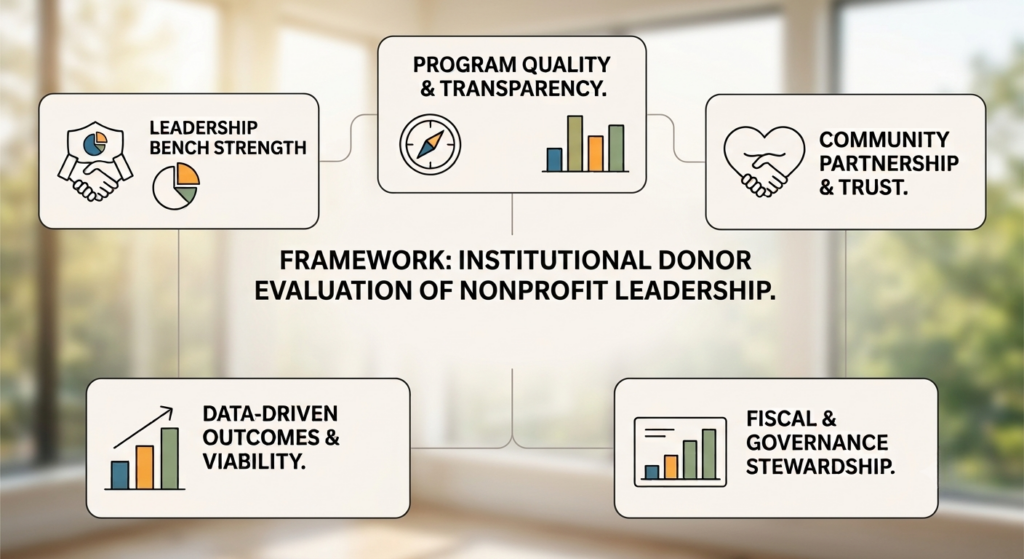
You found a children’s nonprofit in Los Angeles that looks promising, and now you’re wondering whether the people running it can actually deliver on their mission. That question matters more than most donors realize, because leadership quality determines whether your gift reaches kids or gets lost in overhead and mismanagement.
This guide walks through the same evaluation process that foundations and major donors use before writing large checks, from reviewing public filings and board composition to conducting site visits and spotting red flags.
Why institutional donors vet children nonprofit leadership in Los Angeles
To evaluate a children’s nonprofit in Los Angeles before donating, start by checking their official tax filings on GuideStar or Charity Navigator. Then review the board of directors for community diversity and relevant expertise. Finally, read annual reports to verify financial transparency and program outcomes.
Leadership quality determines whether your donation actually reaches children. The executive director and board control how therapy dollars get spent, who has access to kids, and what safety policies exist. A disengaged board or inexperienced executive can mean delayed services, misallocated funds, or gaps in child protection.
Los Angeles has hundreds of children’s charities. You’ll find well-run organizations alongside those with governance problems, and the difference isn’t always obvious from a website. Taking time to evaluate leadership protects both your gift and the families who depend on early intervention services.
- Fiduciary responsibility: Leaders control how donations are spent
- Program continuity: Strong leadership keeps services running through staff turnover
- Child safety: Leadership sets the culture around safeguarding policies
- Regulatory compliance: California has specific nonprofit reporting requirements
How institutional donors structure the due diligence process
Due diligence is a formal review process to verify a nonprofit’s claims and assess risk before making a gift. Foundations and major donors follow a step-by-step approach, and individual donors can adapt the same process for their own giving.
1. Define the grant thesis and risk tolerance
Donors first clarify what outcomes they want to fund. If you care about early intervention therapy, you’ll look for organizations with specific programming in that area. This step shapes every evaluation criterion that follows.
2. Collect public records and state filings
The first documents donors gather are free and publicly available. You can find IRS Form 990 filings on GuideStar or ProPublica Nonprofit Explorer. California Registry of Charitable Trusts filings and Secretary of State business records are also searchable online. These filings reveal basic financial health, governance policies, and whether the organization is in good standing with regulators.
3. Request internal documents from the nonprofit
Serious donors ask for documents that aren’t publicly available. Board meeting minutes, audited financials, strategic plans, and safeguarding policies all fall into this category. A nonprofit that hesitates to share these materials raises questions about transparency.
4. Interview leadership and independent references
Documents tell part of the story. Donors also speak directly with the executive director, board chair, and outside parties like former funders or partner organizations. These conversations verify what the paperwork claims and reveal organizational culture.
5. Score the nonprofit against a written rubric
Institutional donors use standardized scoring sheets to compare organizations and justify funding decisions to their own boards. Even individual donors can create a simple checklist to evaluate multiple charities consistently.
Board composition and governance review
The board of directors hires and fires the executive director, approves budgets, and bears legal responsibility for the organization. A weak or disengaged board often signals organizational risk that will eventually affect programs.
Board independence and conflict of interest disclosures
An independent board member is someone with no financial or family relationship with staff. Donors look for written conflict of interest policies and signed annual disclosures from each board member. When a board is composed entirely of the founder’s relatives, decision-making becomes concentrated and accountability disappears.
Committee structure and audit oversight
Functional boards have committees for finance, audit, and governance. An independent audit committee provides oversight of financial reporting separate from the executive director’s influence. Organizations without this structure may lack the checks that catch problems early.
Board minutes and attendance records
Regular meetings with documented decisions indicate an engaged board. Chronic absences or missing minutes suggest the board exists on paper only. Donors reviewing these records can quickly assess whether governance is real or ceremonial.
Executive leadership assessment and succession planning
Beyond the board, donors evaluate the executive director and senior staff. The central question is whether the organization would survive if the current leader left tomorrow.
CEO tenure and founder dependency
Founder’s syndrome occurs when an organization cannot function without its original leader. Donors assess whether decision-making is shared or concentrated in one person. When everything runs through the founder, the organization carries significant transition risk.
Executive compensation benchmarking
Donors compare executive pay to similar organizations using Form 990 data. Both underpayment (which creates retention risk) and overpayment (which raises governance concerns) prompt questions. The goal is compensation that’s reasonable for the organization’s size and location.
Written succession and emergency continuity plans
A basic succession plan includes interim leadership assignments, access to financial accounts, and communication protocols. Organizations without these documents are one health emergency away from operational crisis.
Financial transparency and Form 990 analysis
The IRS Form 990 is the primary public document for evaluating nonprofit finances. Every tax-exempt organization with gross receipts above $50,000 files one annually, and you can access them free through GuideStar or ProPublica.
Reading the 990 for governance signals
Specific sections reveal governance practices:
| 990 Section | What It Reveals |
| Part VI | Conflict of interest policy, whistleblower policy, document retention |
| Schedule J | Executive compensation details |
| Schedule O | Narrative explanations of governance practices |
A “no” answer to governance questions in Part VI doesn’t automatically disqualify an organization, but it prompts follow-up questions about why basic policies aren’t in place.
Program expense ratios and the limits of overhead
The program expense ratio measures what percentage of spending goes to mission versus administration. While useful, this metric is incomplete. Very low overhead can indicate underinvestment in staff, technology, or infrastructure that the organization needs to deliver quality services.
Audited financials and reserve position
An audit is a formal examination by an independent CPA, while a review or compilation provides less assurance. Donors look for a “clean” auditor’s opinion with no material findings. Operating reserves (unrestricted cash that could cover several months of expenses) indicate financial stability.
Program model and early intervention outcomes verification
Donors evaluate whether the nonprofit’s programs actually work. For children’s charities focused on early intervention, this means looking for defined outcomes, data collection methods, and third-party validation.
- Theory of change: A written explanation of how the program creates impact
- Outcome metrics: Specific, measurable indicators the organization tracks
- Data collection: How and when the organization gathers results
- External validation: Whether outcomes have been reviewed by outside evaluators
NGO for special needs donations like Cara Mia Kids that focus on early intervention therapy during the critical developmental window can point to research from the Harvard Center on the Developing Child showing that 80–90% of brain architecture forms before age five.
Child safeguarding policies and mandated reporter compliance
Any nonprofit working directly with children requires formal safeguarding policies. California law designates certain professionals and volunteers who work with minors as mandated reporters, meaning they’re legally required to report suspected child abuse.
Background checks and volunteer screening standards
Donors expect minimum screening that includes criminal background checks, reference checks, and supervised onboarding periods for new volunteers. Organizations that skip these steps create risk for the children they serve.
Incident reporting and documentation protocols
Written procedures for reporting concerns, investigating incidents, and documenting outcomes protect both children and the organization. Donors review whether these protocols exist and whether staff are trained to follow them.
California and Los Angeles regulatory filings donors can review
California has additional reporting requirements beyond federal filings. These state-level records provide another layer of verification.
California Attorney General Registry and Form RRF-1
Form RRF-1 is the Annual Registration Renewal Fee Report that California charities file with the Attorney General. You can search the California Attorney General’s Registry of Charitable Trusts to verify an organization’s registration status and view their filings.
Los Angeles County filings and facility records
Nonprofits operating licensed facilities (therapy centers, group programs) may have county licensing records. The California Community Care Licensing Division maintains these records, and they’re searchable online.
Site visits and leadership interviews
Documents only tell part of the story. Visiting the nonprofit in person and speaking directly with leadership reveals organizational culture and verifies claims that paperwork can’t capture.
Questions to ask the executive director
- What is your biggest operational challenge right now?
- How do you measure whether your programs are working?
- What would happen to the organization if you left tomorrow?
- How do you handle a safeguarding concern?
Questions to ask the board chair
- How often does the board meet, and what does a typical meeting cover?
- When did the board last update the strategic plan?
- How is executive performance evaluated?
- Has the board ever had to address a serious conflict of interest?
What a complete nonprofit due diligence report includes
Institutional donors compile their findings into a formal report. Understanding what each section contains helps individual donors create their own simplified version.
| Report Section | Key Questions Answered |
| Executive Summary | Should we fund this organization? |
| Governance Findings | Is the board functional and independent? |
| Financial Analysis | Is the organization financially stable? |
| Program Findings | Do the programs deliver results? |
| Risk Register | What could go wrong and how is it managed? |
The risk register lists identified concerns (leadership transition, funding concentration, regulatory issues) alongside steps the nonprofit has taken to address them.
Red flags that can stop a donation
Some warning signs indicate a donor may want to reconsider:
- No independent board members or a board composed entirely of family and staff
- Refusal to share audited financials or Form 990
- No written child safeguarding policy
- Executive compensation far above comparable organizations
- Lapsed California Attorney General registration
- No measurable outcomes or resistance to discussing results
- High staff turnover in leadership positions
Giving with confidence to a Los Angeles children nonprofit
Thorough evaluation protects both donors and children. Strong nonprofits welcome scrutiny because it validates their work and builds trust with supporters.
When you take time to review leadership, governance, and outcomes, you’re being responsible. The children and families who depend on early intervention services deserve donors who care enough to ask hard questions.
Tip: Start with the free public filings (Form 990, California Registry) before requesting internal documents. You can often identify red flags without any direct contact with the organization.
Learn More Children Nonprofit Donations
Frequently asked questions about evaluating children nonprofit leadership in Los Angeles
What is the 33% rule for nonprofits?
The 33% rule refers to an IRS public support test requiring public charities to receive at least one-third of their funding from public sources rather than a small group of donors. Nonprofits that fail this test may be reclassified as private foundations with different tax treatment.
What is the 80/20 rule for nonprofits?
The 80/20 rule is a guideline suggesting nonprofits spend at least 80% of their budget on program services and no more than 20% on administration and fundraising. This is a general benchmark, not a legal requirement, and the appropriate ratio varies by organization type.
How long does nonprofit due diligence typically take before a major gift?
A thorough due diligence process for a major gift typically takes four to eight weeks, depending on how quickly the nonprofit provides requested documents and schedules interviews. Simpler reviews for smaller gifts can be completed in a few days using publicly available filings.
Can donors fund restricted programs or unrestricted operations?
Unrestricted gifts give nonprofits flexibility to cover overhead, respond to unexpected needs, and invest in organizational capacity. Restricted gifts ensure funds go to a specific program but can strain organizations that lack funding for core operations.