
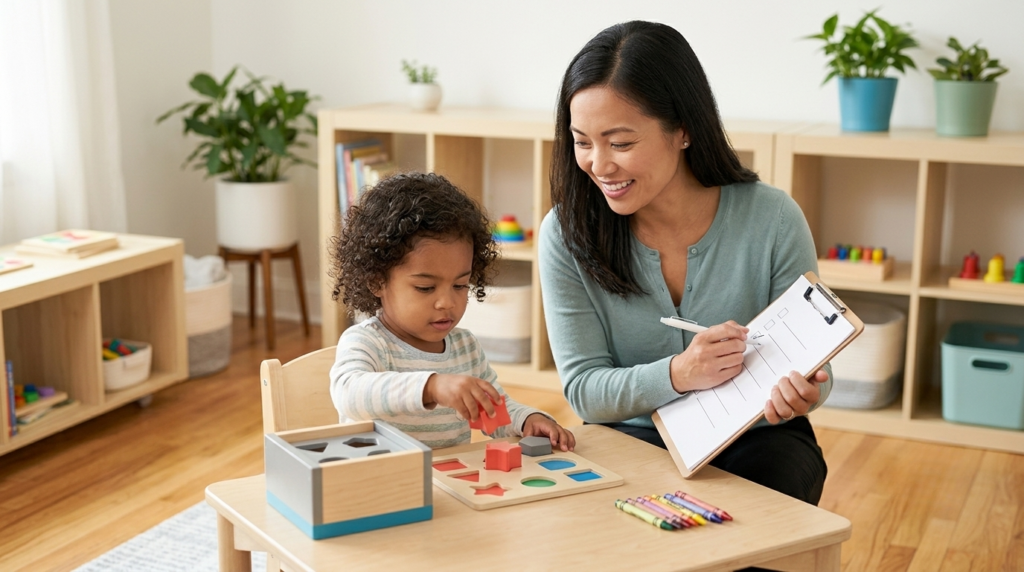
Your child’s third birthday is coming up, and you’re wondering if they’re ready for preschool. Maybe they’re not talking as much as the neighbor’s kid, or they still need help with everything from getting dressed to using the bathroom.
A preschool skills checklist helps you see where your child is right now across the areas that matter most: social skills, language, thinking, movement, and self-care. This guide walks through what 3 year olds typically do in each area, what red flags to watch for, and what to do if your child isn’t hitting certain milestones.
Why Age Three Is a Critical Window for Preschool Readiness
A preschool skills checklist for 3 year olds covers four main developmental areas: social and emotional skills, language and communication, cognitive abilities, and motor skills. The CDC’s “Learn the Signs. Act Early” program outlines what children typically do by age three, including playing with other children, speaking in sentences of three or more words, drawing a circle when shown how, and following two-step directions.
Not every 3 year old will check every box, and that’s okay. Children develop at different paces. The point of a checklist is awareness: knowing what to look for so you can celebrate progress and notice areas where your child might benefit from extra support.
How to Use a Preschool Skills Checklist for Your 3 Year Old
The best time to observe your child’s skills is during everyday moments. Watch how your child plays with blocks, talks to you at dinner, or follows directions during bath time. Formal testing situations don’t show you what a child can do when they’re relaxed and comfortable.
Skills often emerge gradually rather than all at once. Your child might follow a two-step direction on Monday and seem to forget how on Wednesday. That’s normal. What matters is the overall pattern over weeks and months, not any single moment.
Here’s how to get the most out of a developmental checklist:
- Observe during play: Notice how your child solves problems, interacts with toys, and engages with other kids
- Track progress over time: Jot down what you see so you can spot patterns rather than isolated moments
- Share observations with your pediatrician: Bring your notes to well-child visits for a more specific conversation
Social and Emotional Skills a 3 Year Old Typically Has
Social and emotional development at three looks like a child who notices other people’s feelings and can manage their own emotions, at least some of the time. These skills form the foundation for making friends and succeeding in a classroom.
Playing With Other Children
Around age three, children move from parallel play (playing next to other kids) to interactive play (playing with them). You might see your child start a pretend game with another child or take turns pushing toy cars back and forth. You’ll also notice your child watching what other kids are doing and trying to join in.
Managing Emotions and Transitions
Three year olds still have tantrums. But they’re beginning to calm down within a few minutes after getting upset. You might see your child take deep breaths, ask for a hug, or say “I’m mad” instead of hitting.
Transitions between activities can still be hard. A child who melts down every time you leave the park is showing typical 3-year-old behavior.
Following Simple Rules and Routines
At this age, children can follow familiar routines like brushing teeth before bed or putting shoes by the door. They’re also beginning to understand simple rules, like “we don’t throw toys.” Taking turns is emerging but inconsistent. Your child might share a toy one moment and grab it back the next.
Showing Empathy and Sharing
You’ll see early signs of empathy: your child might pat a crying friend on the back or bring you a blanket when you’re sick. Sharing is still developing and often requires adult support.
Language and Communication Milestones for 3 Year Olds
Language development at three is exciting because children become real conversationalists. They’re not just labeling objects anymore. They’re asking questions, telling stories, and expressing opinions.
Speaking in Short Sentences
According to the CDC, 3 year olds typically speak in sentences of three or more words. You might hear “I want juice” or “Daddy go work.” Grammar isn’t perfect yet, and that’s expected.
Following Two Step Directions
A two-step direction sounds like “Pick up your shoes and put them by the door.” This is different from a one-step direction because it requires your child to hold two pieces of information in mind at once. If your child consistently struggles with two-step directions, try breaking them into single steps first.
Asking and Answering Questions
Three year olds ask “who,” “what,” “where,” and “why” questions constantly. They can also answer simple questions like “What’s your name?” and “How old are you?” The “why” phase can feel endless, but it shows your child is curious about how the world works.
Being Understood by Unfamiliar Adults
By age three, strangers can understand most of what your child says, even if some words are unclear. If only family members can understand your child, that’s worth mentioning to your pediatrician.
Cognitive and Learning Skills for 3 Year Olds
Cognitive skills involve thinking, problem-solving, and understanding how things work. At three, children are making connections and figuring things out in ways that might surprise you.
Sorting and Matching by Shape and Color
Your child can likely match basic colors and sort objects by shape. You might see this during play: putting all the red blocks in one pile or finding the circle piece for a puzzle.
Understanding Counting and Numbers
Three year olds know some numbers and are beginning to count objects. They might count “one, two, three, five” while pointing to blocks. The sequence isn’t always right, but the concept is developing.
Solving Simple Puzzles
The CDC notes that children this age can complete 3- or 4-piece puzzles. Puzzle-solving shows spatial reasoning, which is the ability to understand how pieces fit together.
Pretend Play and Imagination
Make-believe play becomes elaborate at three. Your child might pretend a banana is a phone, host a tea party for stuffed animals, or act out scenes from a favorite book. Imaginative play builds language, social skills, and problem-solving all at once.
Fine and Gross Motor Skills for 3 Year Olds
Motor skills fall into two categories. Fine motor skills involve small muscle movements like holding a crayon. Gross motor skills involve large muscle movements like running and climbing.
Running, Climbing, and Balancing
By three, most children can run without falling frequently, climb playground equipment, and walk up stairs alternating feet (instead of putting both feet on each step). They can also kick a ball forward and pedal a tricycle.
Holding a Crayon and Copying Shapes
The CDC milestone checklist notes that 3 year olds can draw a circle when shown an example. Your child is also developing a tripod grip, which means holding the crayon with the thumb and two fingers. This grip takes practice.
Using Scissors With Supervision
Children this age are beginning to snip paper with child-safe scissors. They might not cut along a line yet, but the hand strength and coordination are developing.
Dressing With Minimal Help
Your child can probably put on loose clothing like a jacket or elastic-waist pants. Buttons, zippers, and snaps are still challenging and will develop over the next year or two.
Early Literacy and Math Skills for Preschool Readiness
Early literacy and math skills prepare children for classroom activities. Preschools don’t expect mastery on day one. Exposure to letters, numbers, and books builds a foundation.
Recognizing Letters in Their Name
Many 3 year olds recognize the first letter of their name, especially if they see it often. They’re not expected to know the full alphabet.
Enjoying Books and Storytime
A child who wants to be read to, turns pages, and looks at pictures is building reading readiness. They might “read” a familiar book by retelling the story from memory.
Counting Objects to Ten
Rote counting (saying numbers in order) and one-to-one correspondence (pointing to each object while counting) are both emerging. Your child might count to ten but skip numbers or count the same object twice.
Naming Basic Shapes and Colors
Three year olds can typically name some colors correctly and identify basic shapes like circles, squares, and triangles.
Self-Care and Independence Skills Before Preschool
Many preschools expect children to handle basic self-care tasks with minimal help.
| Skill | What It Looks Like at Age Three |
| Toileting | Uses the toilet with reminders; may need help wiping |
| Hand washing | Washes and dries hands with minimal assistance |
| Eating | Uses a fork and drinks from an open cup |
| Dressing | Pulls on loose pants, puts on jacket |
Using the Toilet With Reminders
Many preschools require children to be toilet trained, though accidents are still normal at three. Children often need reminders to use the bathroom, especially when they’re busy playing.
Washing Hands and Basic Hygiene
According to the CDC, 3 year olds can wash and dry their hands. They might need supervision to use soap and dry thoroughly, but they can do the basic steps.
Feeding Themselves With Utensils
Your child can use a fork consistently and drink from an open cup without spilling often. Spoons for soup and cutting with a knife come later.
Red Flags and Signs of Developmental Delay at Age Three
One missed milestone isn’t cause for alarm. However, patterns of delays or losing skills your child once had are worth discussing with your pediatrician.
According to the CDC, contact your child’s doctor if your 3 year old:
- Does not make eye contact or respond to their name
- Cannot speak in sentences or is very difficult to understand
- Shows no interest in other children
- Cannot follow simple instructions
- Loses skills they once had
- Has extreme difficulty with transitions or changes in routine
If something feels off, trust your instincts and ask. Early intervention services exist specifically because addressing delays early makes a difference.
Activities to Build Preschool Skills at Home
You don’t need special equipment or training to support your child’s development. Everyday activities build skills naturally.
1. Read Aloud Every Day
Reading builds vocabulary and listening skills. Even five minutes before bed counts.
2. Set Up Play Dates and Group Play
Social skills develop through practice. Time with other children, whether at the park or a friend’s house, gives your child opportunities to share, take turns, and work through conflicts.
3. Give Simple Chores and Choices
Letting your child put napkins on the table or choose between two shirts builds independence and decision-making.
4. Practice Fine Motor Skills Through Art
Crayons, playdough, and stringing large beads all strengthen the small muscles needed for writing. The CDC specifically mentions stringing beads or macaroni as a milestone activity.
5. Narrate and Ask Open Ended Questions
Instead of yes-or-no questions, try “What do you think will happen next?” or “Tell me about your picture.” Open-ended questions build language and reasoning.
What to Do If Your Child Is Missing Skills on the Checklist
If you’re concerned about your child’s development, there are concrete steps you can take.
Step 1. Write Down What You Are Seeing
Keep notes on specific behaviors rather than general impressions. “She doesn’t respond when I call her name from across the room” is more useful than “She seems behind.”
Step 2. Talk to Your Pediatrician
Pediatricians screen for developmental delays at well-child visits, but you can request a screening anytime. Bring your notes so you can describe exactly what you’ve observed.
Step 3. Request a Free Developmental Evaluation
Under the Individuals with Disabilities Education Act (IDEA) Part B, public school districts provide free evaluations for children aged 3 and older if a delay is suspected. You don’t need a referral from your pediatrician to request one.
Step 4. Explore Early Intervention Services
If delays are identified, therapies like speech, occupational, or physical therapy can help your child build skills during this developmental window. NGO for special needs donations like Cara Mia Kids help families access therapy services regardless of financial circumstances.
Supporting Every Child on the Path to Preschool
Every child develops at their own pace, and a checklist is one tool for understanding where your child is right now. What matters most is paying attention, celebrating progress, and getting support when something doesn’t feel right.
If you’re worried, you’re not overreacting. Parents notice things. Early support during the preschool years can change the trajectory of a child’s life, and no family should go without care because of financial circumstances.
Learn More about child developement delays
Frequently Asked Questions About Preschool Skills for 3 Year Olds
How do I know if my 3 year old is behind or just a late bloomer?
If your child is missing several milestones across different areas, or has lost skills they previously had, talk to your pediatrician rather than waiting. A single skill developing slowly is often normal. A pattern of delays across social, language, and motor skills warrants a closer look.
Does my 3 year old need to know letters and numbers before starting preschool?
Most preschools do not expect children to know letters or numbers on the first day. Children learn letters and numbers during preschool, not before. Exposure to books and counting games at home helps, but mastery isn’t expected.
Can a child with a developmental delay still attend a regular preschool program?
Many children with delays attend inclusive preschool settings, sometimes with additional support services. A speech therapist might visit the classroom, or a child might receive occupational therapy before or after school.
Are developmental evaluations for 3 year olds free in the United States?
Under IDEA Part B, public school districts provide free evaluations for children aged 3 and older if a developmental delay is suspected. You can contact your local school district directly to request an evaluation without a doctor’s referral.
How long does early intervention therapy take to help a child catch up on preschool skills?
Progress varies by child and the nature of the delay. Some children make gains within a few months of starting therapy, while others benefit from ongoing support throughout their preschool years.