
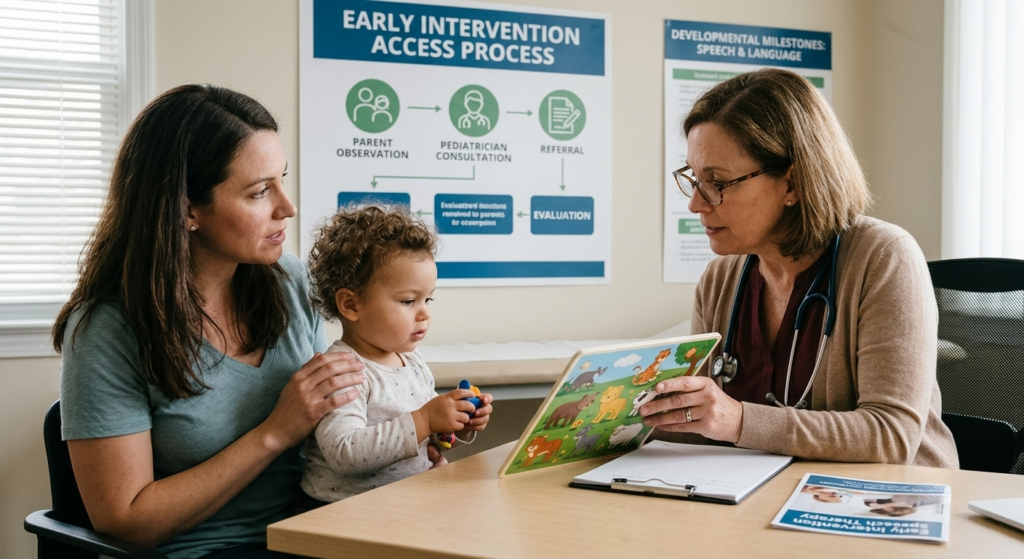
Your toddler isn’t talking yet, and you’re starting to wonder if waiting is the right call. Maybe they babble less than other kids their age, or they get frustrated when they can’t tell you what they want.
Early intervention speech-language pathology helps children from birth to age three who show signs of communication delays. This guide covers how to recognize the signs, what therapy looks like for babies and toddlers, and the exact steps to access free evaluations and services through your state’s program.
What is speech language pathology early intervention
Early intervention speech-language pathology is a service for infants and toddlers from birth to age three who show signs of communication delays or feeding difficulties. A speech-language pathologist (SLP) works with young children during this window to build listening, talking, and social skills through play-based activities woven into daily routines. The American Speech-Language-Hearing Association (ASHA) describes early intervention as a team-based approach designed to help babies and young children who have trouble with skills like walking and talking.
Federal law guarantees access to early intervention through the Individuals with Disabilities Education Act (IDEA) Part C. Every state runs its own program, and families can request a free evaluation without a doctor’s referral or a formal diagnosis. If your child qualifies, services are provided at no cost or low cost depending on your state’s policies.
A speech-language pathologist is a specialist trained to help children with talking, understanding words, making sounds, eating, swallowing, and connecting with others. You might hear them called speech therapists, and they work alongside other professionals like occupational therapists and developmental specialists.
Why early speech intervention matters before age 3
The first three years of life are when a child’s brain builds its foundation for language. According to the Harvard Center on the Developing Child, roughly 80 to 90 percent of brain architecture forms before age five, with the most rapid development happening in the earliest years. This is why speech therapy during infancy and toddlerhood can produce results that become harder to achieve later.
Think of it this way: a toddler’s brain is forming over a million neural connections every second. When a child practices communication skills during this period, those connections strengthen. When delays go unaddressed, the brain moves on to other developmental tasks, and catching up becomes more difficult.
A two-year-old who struggles to express basic wants may become a four-year-old with frequent tantrums, a kindergartener who avoids speaking in class, or a first-grader who falls behind in reading. Early intervention takes advantage of the brain’s natural ability to form and reorganize connections, so small delays are less likely to grow into bigger challenges.
Signs your child may need early speech therapy
Parents usually notice first. Maybe your toddler is quieter than other kids at the playground, or maybe they get frustrated and cry when they can’t tell you what they want. Trusting that instinct is the first step toward getting answers.
The following milestones and warning signs can help you decide whether to request an evaluation. Keep in mind that every child develops at their own pace, but consistent gaps across several areas often signal a reason to look closer.
Speech and language milestones from birth to age 3
| Age | What you might see and hear |
| 0–6 months | Coos, laughs, turns toward sounds, responds to your voice |
| 6–12 months | Babbles with consonants like “ba-ba” or “da-da,” responds to their name, understands “no” |
| 12–18 months | Says first words like “mama” or “ball,” follows simple directions like “give me the cup” |
| 18–24 months | Uses two-word phrases like “more milk,” vocabulary grows to around 50 words |
| 24–36 months | Speaks in short sentences, familiar adults understand most of what they say |
The CDC publishes developmental milestone guidelines that pediatricians use during well-child visits. If your child is missing several milestones for their age, an evaluation can clarify whether support would help.
Red flags in toddler communication
Some signs stand out more than others. Here are patterns that often prompt families to seek an evaluation:
- Limited babbling by 12 months: Your baby is unusually quiet and doesn’t experiment with sounds.
- No words by 18 months: Your toddler hasn’t said any recognizable words, even simple ones.
- Loss of skills: Your child stops using words or gestures they used before.
- Difficulty following directions: Your toddler doesn’t respond to simple requests like “come here.”
- Frustration during communication: Frequent meltdowns happen when your child tries to tell you something.
If you recognize two or more of these patterns, requesting a free evaluation through your state’s early intervention program is a reasonable next step. You don’t need to wait for a diagnosis or a doctor’s referral.
What a speech language pathologist does in early intervention
An SLP starts by evaluating your child’s current communication abilities. The assessment looks at how your child understands language (receptive skills), how they express themselves (expressive skills), how they produce sounds (articulation), and how they interact with others (social communication). For some children, the evaluation also includes feeding and swallowing.
After the evaluation, the SLP works with you to set goals based on your child’s specific needs and your family’s priorities. Therapy might focus on helping your child say their first words, follow directions, use gestures to communicate, or eat safely. The goals become part of a written plan that guides the work.
One thing that surprises many parents: the SLP spends a lot of time coaching you. Because you’re with your child far more than any therapist, learning strategies to use at home is part of the process. You become a partner in therapy, not just someone who drops off and picks up.
Approaches speech therapists use with young children
Therapy for babies and toddlers looks different than therapy for older children. Sessions are shorter, more playful, and often happen in your living room instead of a clinic. Here’s what that looks like in practice.
Play-based speech therapy
Therapists build language goals into activities your child already enjoys. Blowing bubbles creates chances for your child to request “more” or say “pop.” Stacking blocks encourages turn-taking and simple words like “up” or “my turn.” Rolling a ball back and forth teaches the rhythm of conversation.
Play keeps children engaged while building real skills. A toddler doesn’t know they’re in therapy; they just know they’re having fun with an adult who’s paying close attention to them.
Family and parent coaching
You spend far more hours with your child than any therapist ever will. That’s why SLPs teach parents specific strategies to use during meals, bath time, car rides, and play. The goal is for communication practice to happen throughout the day, not just during a weekly session.
This approach, sometimes called family-centered practice, helps children use new skills in real situations. When you learn to pause and wait for your child to respond, or to expand on their words (“Ball!” becomes “Yes, big red ball!”), you’re doing therapy without calling it that.
Natural environment sessions
IDEA Part C prioritizes therapy in “natural environments,” meaning the places where your child already spends time. Sessions often happen at home, in daycare, or at a grandparent’s house. Familiar settings help children feel comfortable and make it easier to practice skills in real-life situations.
A therapist working in your kitchen can show you how to turn snack time into language practice. A therapist at daycare can help caregivers support your child’s communication throughout the day.
Team-based care with other therapists
Speech-language pathologists often work alongside occupational therapists, physical therapists, developmental specialists, and service coordinators. Together, this team creates a single plan called an Individualized Family Service Plan (IFSP) that addresses all of your child’s developmental needs in a coordinated way.
If your child is working on both speech and motor skills, for example, the therapists communicate with each other so the goals fit together. You attend meetings with the whole team and have a say in how services are delivered.
Where early intervention speech therapy happens
Most early intervention sessions take place in the home or in childcare settings. Some families prefer clinic-based therapy, especially if their child benefits from a structured environment or specialized equipment.
The choice often depends on your child’s needs and your family’s schedule. Home-based sessions let the therapist see how your child communicates in everyday situations. Clinic sessions may offer access to additional resources or a quieter space. Your service coordinator can help you figure out which setting works best.
How to access early intervention speech services
The process can feel confusing at first, but there are clear steps. You don’t need a referral from a doctor, though your pediatrician can help you get started.
Step 1. Talk to your pediatrician
Mention your concerns at your child’s next well-visit, or call the office between appointments. Pediatricians can screen for developmental delays and provide a referral to your state’s early intervention program. However, you can also contact the program directly on your own.
Step 2. Request a free state evaluation through IDEA Part C
Every state has an early intervention program, and evaluations are free to families. In California, the program is called Early Start. In other states, the lead agency might be the Department of Health or the Department of Education. Once you request an evaluation, the state has a set timeframe (usually 45 days) to complete it.
If you’re unsure where to start, organizations like Cara Mia Kids can help you connect with local programs and walk you through the process.
Step 3. Build an individualized family service plan
If your child qualifies for services, you’ll work with a team to create an IFSP. This document outlines your child’s goals, the services they’ll receive, how often sessions will happen, and your family’s priorities. You are an active participant in creating the plan, and your input matters.
Step 4. Begin weekly therapy sessions
Services typically start soon after the IFSP is signed. Sessions are often 30 to 60 minutes long and may occur once or twice a week, depending on your child’s needs. The therapist will involve you in each session so you can continue practicing at home.
How to pay for early intervention speech therapy
IDEA Part C services are provided at no cost or low cost to families, though specifics vary by state. Evaluations are always free. Beyond Part C, several other funding sources can help cover therapy costs:
- Private insurance: Many plans cover speech therapy with a prescription from your child’s doctor.
- Medicaid and CHIP: Both programs cover early intervention services for eligible families.
- Nonprofit support: Organizations like Cara Mia Kids help families access care regardless of their ability to pay, connecting them with grants, resources, and direct support.
If cost is a concern, ask your service coordinator about all available options. Many families assume they can’t afford care and later discover that help exists.
Supporting your child’s speech at home between sessions
What happens between therapy sessions matters just as much as the sessions themselves. Small, consistent efforts throughout the day add up over time.
- Narrate daily routines: Describe what you’re doing during meals, diaper changes, and play. “I’m pouring the milk. The milk is cold.”
- Follow your child’s lead: Let them choose activities, then add language to their interests. If they’re fascinated by trucks, talk about trucks.
- Expand on their words: If your child says “ball,” respond with “Yes, big red ball!” This models longer phrases without correcting them.
- Read together daily: Point to pictures, pause for your child to fill in words, and ask simple questions about the story.
These strategies come directly from what SLPs teach during parent coaching. Consistency matters more than perfection. Even five extra minutes of intentional talking each day makes a difference.
Building a future where every child can communicate
No child should miss the early intervention window because of cost or access barriers. NGO for special needs donations at Cara Mia Kids, we work with families to connect them with therapies, funding, and support during the years when it matters most.
If you’re looking for help getting started with early intervention, or if you want to support families who need it, we invite you to reach out.
Learn more child early intervention services
FAQs about speech language pathology early intervention
What is the difference between early intervention speech therapy and speech therapy for older children?
Early intervention speech therapy serves children from birth to age three under IDEA Part C. It focuses on family coaching in natural environments and uses play-based methods suited to infant and toddler development. Speech therapy for older children typically follows a school-based or clinic-based model with different goals and structures.
What happens when a child turns 3 and ages out of early intervention?
At age three, children transition to services under IDEA Part B through the local school district. This may include preschool special education or continued speech therapy with a new plan called an Individualized Education Program (IEP). Your early intervention team will help you prepare for this transition starting several months before your child’s third birthday.
Can a child receive early intervention speech services if the family speaks a language other than English?
Yes. Families have the right to services and evaluations in their home language. Early intervention programs are required to provide interpreters or bilingual therapists when available.
How long does early intervention speech therapy typically last?
The length varies based on each child’s needs and progress. Services continue until the child turns three or meets their developmental goals, whichever comes first.