
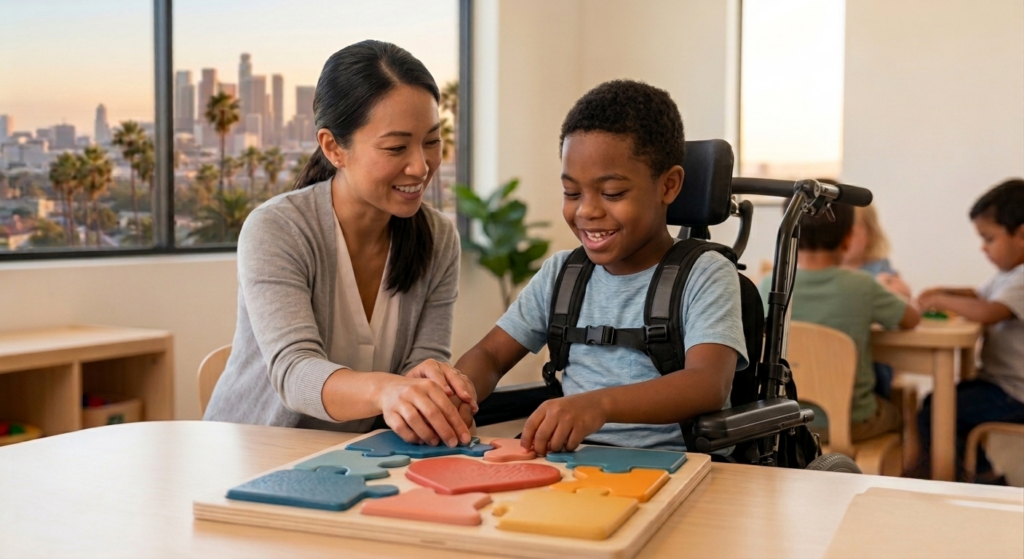
Corporate giving to children’s disability nonprofits in Los Angeles does more than satisfy a line item on your CSR report. It puts therapy, support, and opportunity within reach for families who would otherwise wait months or go without.
The tax benefits are real, but so is the impact. This guide covers what makes a donation deductible, how your dollars translate into therapy sessions and family support, and the specific ways your company can structure its giving for maximum effect.
What makes a donation to a Los Angeles children’s disability nonprofit tax deductible
Your company’s donation to a children’s disability nonprofit in Los Angeles is tax deductible when the organization holds 501(c)(3) status with the IRS. You can check any nonprofit’s status using the IRS Tax Exempt Organization Search tool at irs.gov before you write a check. For California state tax deductions, the nonprofit also has to be registered with the California Franchise Tax Board, which you can verify through the Registry of Charitable Trusts.
Not every type of gift qualifies. Cash, checks, credit card payments, and appreciated stock are all deductible. Property donations and equipment gifts count too, though you’ll want documentation of fair market value. Here’s what doesn’t qualify: the value of your employees’ volunteer hours or professional services your company provides for free. The IRS draws a clear line between giving money or goods versus giving time.
For any gift over $250, the IRS requires a written acknowledgment letter from the nonprofit. This letter confirms how much you gave, the date of the gift, and whether you received anything in return (like event tickets or merchandise). Most nonprofits send these letters within two to four weeks. If you’re making a year-end gift, ask for the acknowledgment promptly so you have it before tax filing deadlines.
- 501(c)(3) verification: Check the IRS Tax Exempt Organization Search before donating to confirm the nonprofit’s federal tax-exempt status
- California registration: Verify the organization appears in the California Registry of Charitable Trusts for state deduction eligibility
- Written acknowledgment: Keep the nonprofit’s letter confirming your gift amount, date, and that no goods or services were exchanged
Why early intervention is the highest return community investment a Los Angeles company can make
Early intervention means specialized therapy and support for children under age five who have developmental disabilities or delays. The timing matters because of how quickly young brains develop. According to the Harvard Center on the Developing Child, roughly 80 to 90 percent of brain architecture forms before a child turns five. Therapy delivered during this window can change how a child learns, moves, and communicates for the rest of their life.
The economic argument is just as clear. Economist James Heckman’s research on early childhood programs found that high-quality early intervention generates a return of 7 to 13 percent per year through better outcomes in education, health, and employment. For companies looking to maximize the community impact of their charitable dollars, few causes offer this combination of measurable outcomes and long-term benefit.
Meanwhile, disability-focused giving remains underrepresented in corporate philanthropy. Many Los Angeles companies support education or environmental causes, but children with special needs often fall through the gaps. A gift to an early intervention nonprofit addresses an urgent, underfunded need while creating lasting change for families in your community.
How your donation directly supports children with disabilities in Los Angeles
Corporate donations to children’s disability nonprofits fund the specialized services that insurance and government programs often don’t fully cover. Physical therapy helps children build strength and mobility. Occupational therapy develops fine motor skills and daily living abilities. Speech therapy supports communication. Many families face waitlists or coverage gaps that delay their child’s access to care, and donations help close those gaps.
Beyond therapy sessions, donations support the families themselves. Parent education programs teach caregivers how to reinforce therapy goals at home. Respite services give exhausted parents a few hours of relief. Emotional support groups connect families facing similar challenges so they don’t feel alone in the process.
Some nonprofits are also working toward longer-term infrastructure. Cara Mia Kids, for example, has a $2 million vision to build a healing ranch and support center designed with accessibility at its core. This kind of inclusive space would give children a place to learn and play without barriers, and give families a community where they belong.
- Therapy access: Donations cover physical, occupational, and speech therapy for children whose insurance falls short
- Family support: Funds provide parent education, respite care, and peer support groups
- Inclusive community spaces: Capital gifts support accessible facilities where every child can participate
Ways your company can give to support children with disabilities
One time corporate gifts
A single cash or stock donation is the simplest way for a company to support a children’s disability nonprofit. This approach works well for businesses without an ongoing giving program or those testing a new charitable partnership. Stock donations of appreciated securities can offer additional tax advantages by avoiding capital gains taxes on the appreciation.
Recurring monthly giving
Monthly giving provides nonprofits with predictable funding they can count on for program planning. For your company, it simplifies budgeting by spreading contributions across the fiscal year. Even modest monthly amounts add up quickly. A $500 monthly commitment becomes $6,000 annually, enough to fund therapy sessions for multiple children.
In kind donations of goods and services
In-kind gifts include physical items like therapy equipment, sensory toys, or accessible playground materials. Office supplies, technology, and professional services (such as legal or accounting support) also qualify. The nonprofit will provide documentation of fair market value, which your company can use for tax purposes. Keep in mind that while the goods are deductible, the value of donated professional services is not.
Employee matching gift programs
Matching programs amplify individual employee donations by having the company contribute an equal or greater amount. If an employee gives $100 to a qualified nonprofit, the company matches with another $100, doubling the impact. These programs increase employee engagement with charitable giving while strengthening your company’s community investment.
Corporate sponsorship levels for Los Angeles disability nonprofits
Many children’s disability nonprofits offer tiered sponsorship structures that provide different levels of recognition and engagement. Understanding these tiers helps your company choose a commitment that aligns with your budget and goals.
| Sponsorship Level | Typical Commitment | Recognition and Engagement |
| Program Sponsor | Single program funding | Logo on program materials, impact reports |
| Family Sponsor | Ongoing family support | Direct updates, site visits |
| Founding Partner | Capital campaign gift | Naming opportunities, advisory role |
Program sponsor
Program sponsorship funds a specific service area, such as a summer therapy program or parent education series. Your company receives recognition on program materials and regular impact reports showing how your dollars were used. This level works well for companies that want a clear, measurable connection between their gift and outcomes.
Family sponsor
Family sponsorship provides sustained support for one family’s therapy journey over time. Sponsors typically receive updates (with family permission) about the child’s progress and may have opportunities to visit the program. This creates a more personal connection to your company’s community investment.
Founding partner of the healing ranch
Capital campaign gifts support long-term infrastructure projects. For Cara Mia Kids, founding partners contribute to the $2 million healing ranch vision, an accessible space where children can receive therapy, families can connect, and lasting memories can be made. Founding partners often receive naming opportunities and may serve in an advisory capacity during development.
Engaging employees through volunteer days and fundraising events
Volunteer days with local therapy programs
Corporate volunteer days give employees hands-on experience with the cause your company supports. Typical activities include facility maintenance, event setup, administrative support, or organizing supply drives. Direct interaction with children usually requires background checks and training, so coordinate with the nonprofit in advance to find appropriate roles for your team.
Team fundraising events
Company-organized fundraisers, such as walkathons, galas, or peer-to-peer campaigns, combine team building with charitable impact. Employees who participate in fundraising often feel more connected to the cause and to each other. These events also raise awareness of your company’s community investment among clients, vendors, and the broader public.
Workplace giving campaigns
Payroll deduction programs allow employees to contribute a portion of each paycheck to a designated nonprofit. Annual giving drives can focus attention on a specific cause and encourage participation across departments. These campaigns are straightforward to administer and create a culture of giving within your organization.
Documenting your tax deductible donation for CSR reporting
Proper documentation protects your company’s tax deduction and provides material for corporate social responsibility reports. Keep acknowledgment letters from every nonprofit you support, along with bank statements or canceled checks showing payment.
For non-cash donations valued above $5,000, IRS Form 8283 requires a qualified appraisal. The nonprofit can help you understand valuation requirements for specific items like equipment or property.
When preparing CSR reports, request impact data from the nonprofits you support. Metrics like the number of children served, therapy sessions provided, or families reached give your stakeholders a concrete picture of what your investment accomplished.
- Acknowledgment letters: Retain letters confirming donation amount, date, and nonprofit tax ID for your records
- Valuation records: Obtain qualified appraisals for non-cash gifts above $5,000 as required by IRS Form 8283
- Impact metrics: Request data from nonprofits showing outcomes like children served or therapy sessions funded
Partnering with Cara Mia Kids as your Los Angeles community investment
Cara Mia Kids focuses on early intervention therapy and support for children with special needs in Los Angeles. The organization helps families access physical, occupational, and speech therapy during the critical early years when intervention has the greatest impact.
The $2 million healing ranch project offers a tangible, long-term opportunity for corporate partners who want to leave a lasting mark on the community. Companies interested in sponsorship, matching gifts, or volunteer partnerships can reach out to discuss options that fit their goals.
Learn More Donation to Children With Disability in Los Angeles
Frequently asked questions about tax deductible donations to children with disabilities in Los Angeles
Is my corporate donation deductible on both federal and California state taxes?
Yes. Donations to qualified 501(c)(3) organizations are deductible on both federal and California state corporate tax returns, provided the nonprofit is registered with the California Franchise Tax Board. You can verify California registration through the Registry of Charitable Trusts.
What is the annual deduction limit for corporate charitable contributions?
The IRS limits corporate charitable deductions to 10 percent of taxable income in most years. Contributions exceeding this limit can be carried forward for up to five tax years. Consult your tax advisor for guidance specific to your company’s situation.
Can a publicly traded company make a tax deductible donation to a 501(c)(3)?
Yes. Publicly traded companies regularly make tax deductible donations to 501(c)(3) nonprofits, often through corporate foundations or direct giving programs. These contributions follow the same IRS rules as donations from privately held companies.
How quickly will my company receive an acknowledgment letter after donating?
Most nonprofits issue written acknowledgment letters within two to four weeks of receiving a gift. For year-end donations, request documentation promptly to ensure you have records before tax filing deadlines.
Can my company restrict its gift to a specific program or child?
Many nonprofits accept restricted gifts designated for specific programs, such as therapy services or capital projects. Restrictions on gifts to individual children are typically limited by privacy policies and the nonprofit’s commitment to serving all families equitably. Ask the organization about their policies before making a restricted gift.